“We’re using the same audience demographics across Facebook, Google, and our direct mail, so we’re doing omnichannel marketing.”
Does this sound like something you or your team has said recently?
Here’s the harsh reality: simply choosing the same attributes in different channels is NOT omnichannel marketing, as you’re not targeting the same audience across platforms. You’re targeting similar audiences. While these audiences might share similar demographics, interests, etc., they’re probably entirely different individuals.
Most industry experts and studies suggest that a prospect typically needs to see a consistent message at least 6 to 7 times across different channels before it is retained and recognized, a principle often referred to as the “Rule of 7” in advertising. However, if you’re not reaching the same audience consistently across different channels, you may not be creating the consistent brand reinforcement needed to build trust and drive action.
The crux of the problem: Marketers think they’re doing omnichannel marketing, but they’re really doing multichannel marketing.
Understanding the difference between omnichannel and multichannel strategies (and implementing real omnichannel campaigns) is the key to unlocking better ROI and more efficient marketing efforts.
What Is Multichannel Marketing?
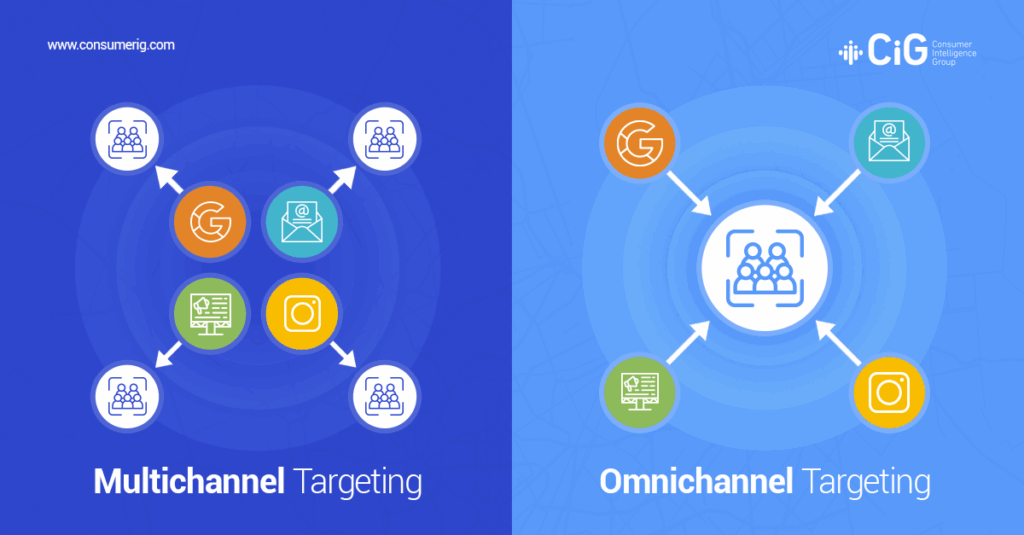
Multichannel marketing involves promoting your product or brand across multiple platforms—like Facebook, Instagram, Google Ads, email, and SMS—without necessarily connecting the dots between them.
Sometimes, marketers do multi-channel marketing explicitly, targeting different audiences across platforms and running unique campaigns with different messaging.
At the same time, many marketers will use similar messaging and shared demographic filters across platforms, trying to reach the same audience, but this doesn’t work out as planned. Without centralized data or cross-channel tracking, each platform builds and delivers to its own version of your audience. What feels like a coordinated effort might actually be a series of disconnected impressions
What Is Omnichannel Marketing?
Omnichannel marketing is an audience-first approach to targeting, where you start by building your audience and then push that same audience to all of the channels where they’re active. This is fundamentally different from multichannel marketing, which takes a channel-first approach—starting with the channels and building separate audiences on each channel.
Watch: CiG CEO Tim Leys explain why audience-first prospecting gives you total control over your targeting, while channel-first approaches lock you into each platform’s ecosystem.
This audience-first strategy ensures that you’re reaching the exact same households across every touchpoint, creating unified brand messaging and consistent experiences.
Rather than fragmenting your targeting across platforms, omnichannel marketing uses a unified identifier to maintain audience consistency across all marketing channels, delivering a seamless experience.
What Most Marketers Get Wrong About Omnichannel Marketing
The Platform Interpretation Problem
As already discussed, a common misconception we hear from some advertisers is the belief that they are reaching the same target audience across all channels by selecting the same audience attributes across multiple media platforms (Facebook, DV360, TikTok, etc.).
We’ve already debunked this myth in the first half of the article. Let’s look into some other misconceptions that marketers have about omnichannel marketing that are impeding them from running true omnichannel campaigns.
The Cost Assumption
Another major barrier is the assumption that omnichannel marketing is too expensive and therefore intangible for most marketers. This assumption stems from the traditional omnichannel landscape, where marketers needed multiple expensive data licenses to build audiences outside of platforms.
However, with modern technology, like intelligentVIEW (more on intelligentVIEW later), omnichannel marketing is no longer reserved for large enterprises with substantial budgets. Organizations of all sizes can now build data-driven, omnichannel campaigns without the significant overhead.
The Complexity Assumption
Another major barrier is the assumption that omnichannel marketing is too complex, especially when it comes to data licensing. Traditionally, marketers needed to juggle multiple third-party data vendors, negotiate expensive contracts, and manage overlapping licenses just to stitch together a usable audience.
For many teams, the sheer effort of sourcing, managing, and aligning data licenses across platforms became a non-starter. But with solutions like intelligentVIEW, that complexity is stripped away.
The Benefits of True Omnichannel Marketing
When executed correctly, an effective omnichannel marketing strategy delivers measurable advantages:
- Dramatically Improved ROAS: True omnichannel retail approaches deliver significantly higher returns when you’re actually reaching the same customers across channels, not just people with similar demographics.
- Seamless Prospect Engagement: Build reach and frequency across multiple touchpoints and the channels your optimal target audience prefers, ultimately driving higher engagement and conversion rates.
- Consistent Brand Experience: Maintain unified brand messaging while optimizing for each channel’s unique strengths, meeting customer expectations across all touchpoints.
- Reduced Media Waste: True omnichannel approaches reduce waste by ensuring you’re not duplicating spend across disconnected audiences.
Want to read more about these benefits? Check out our recent article, “Beyond Siloed Channels: The Measurable Omnichannel Marketing Benefits for Canadian Brands.”
How to Do True Omnichannel Marketing Compliantly and Cost-Effectively
The good news is that a true omnichannel marketing strategy doesn’t have to be complex or cost-prohibitive. Here’s how Canadian marketers can implement an effective omnichannel marketing strategy leveraging the intelligentVIEW platform:
Start with the Right Foundation: The Household Identifier
It all leads back to the six-digit postal code, a privacy-compliant and unique common identifier. This key element enables marketers to reach audiences effectively across digital, social, OOH, and direct channels to create a seamless customer experience.
Household-based targeting works because it’s privacy-compliant (no personal information required), future-proof (resistant to digital identity changes), comprehensive (links online and offline behaviour), and accurate (based on actual geographic location rather than inferred data). This approach helps build consistent experiences across all touchpoints.
intelligentVIEW uses these postal codes as the foundation for household-level targeting while maintaining privacy compliance.
Leverage Integrated Platform Solutions
A successful omnichannel marketing strategy requires a single platform that unifies your entire approach. This way, you can reach and engage the same high-value audience consistently across online and offline channels rather than managing multiple vendors and complex integrations.
intelligentVIEW offers data, insights, and activation in one platform—and it’s the only one in Canada to do that. This enables you to reach the same audience across Meta, Google, The TradeDesk, TikTok, direct mail, and more, creating a seamless omnichannel experience.
Cost-Effective Operations
intelligentVIEW uses simple, transparent subscription-based pricing based on the number of users rather than complex per-impression or per-campaign fees. Unlike traditional solutions, there are no incremental costs per thousand impressions (CPMs) or performance-based media charges. This fixed-cost approach makes omnichannel marketing more accessible, predictable, and scalable.
You can create and run as many targeted audiences as needed—without worrying about additional costs—making it an ideal solution for marketers executing large-scale or always-on campaigns.
The Future of Canadian Marketing is Omnichannel
For Canadian marketers facing rising costs, increasing competition, and evolving privacy requirements, a true omnichannel marketing strategy is becoming essential for sustainable growth and customer retention.
intelligentVIEW is Canada’s only omnichannel marketing platform that enables you to get data and insights and activate audiences across all channels in one place. It’s built to address the unique challenges and complexities of data-driven marketing in Canada, making true omnichannel marketing accessible and cost-effective for businesses of all sizes.
Ready to stop assuming your campaigns are omnichannel and start implementing true cross-channel integration? Request a demo to see how intelligentVIEW can help you target the same audience across every channel and reduce wasted media spend.